Use Case 2: How EigenLens Helps Engineering Teams Decide What to Investigate Next
How an aviation company’s engineering team can use EigenLens to uncover recurring issues in NTSB reports and prioritize investigations into engine power loss.
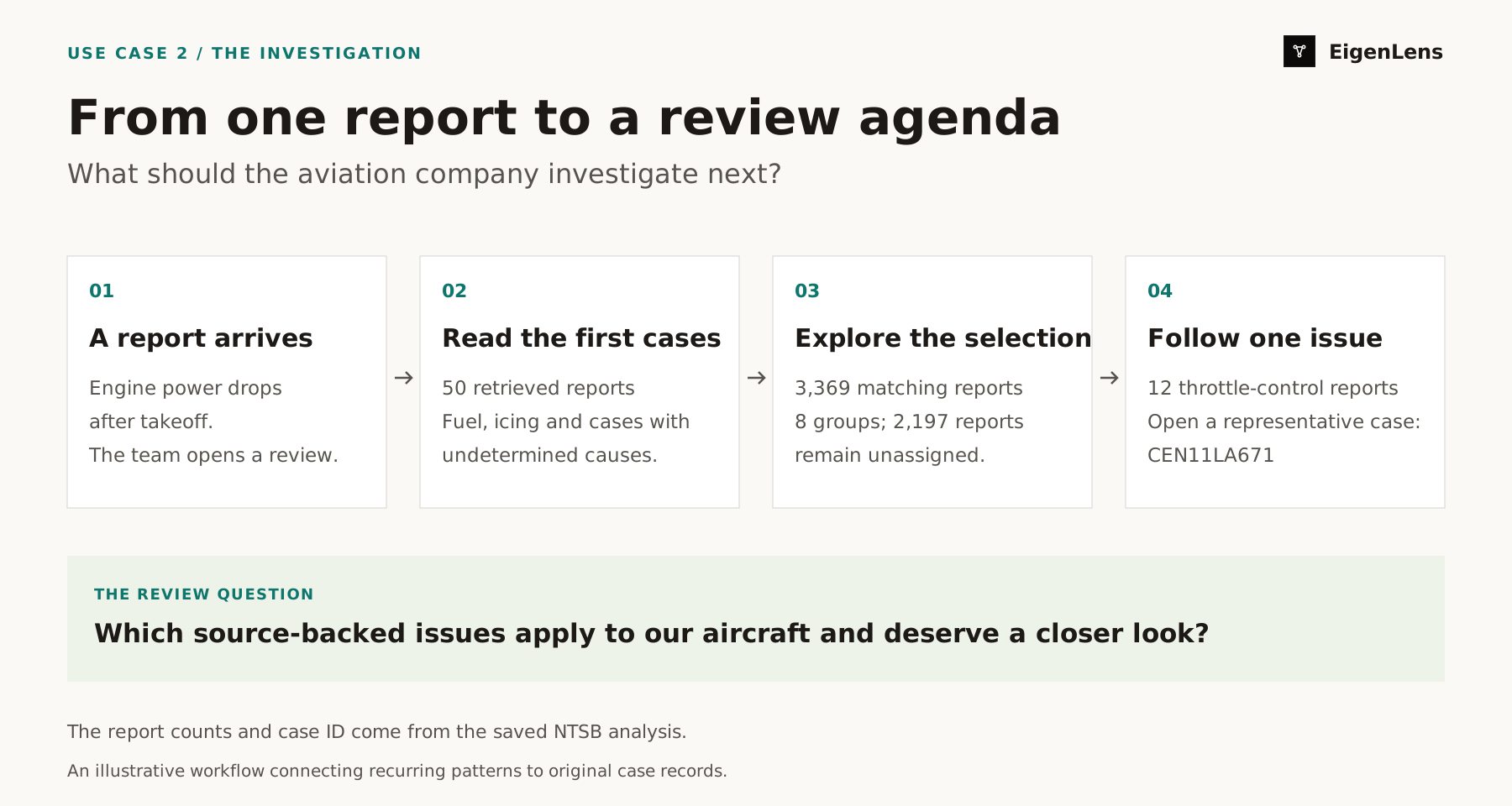
Imagine you lead engineering at an aviation company.
A recent internal report describes an engine losing power after takeoff. Before the weekly reliability review, your team wants to understand whether public investigations reveal related patterns.
Your AI agent already searches aviation reports. You ask:
Show issues in engine power loss during takeoff.
The agent retrieves relevant cases. Your team also needs to know which problems recur and what deserves a closer look.
We explored that question using real NTSB data and EigenLens.
Select a figure to open its full-resolution SVG.
Start with the evidence
We downloaded the NTSB aviation dataset and indexed 28,043 events with usable narratives in Qdrant. The prepared records span January 2008 through September 2026.
Each record retains its case IDs, aircraft metadata and available cause, summary and factual narratives.
The search “engine power loss during takeoff” selected 3,369 reports above a cosine similarity threshold of 0.4. This is a semantic selection: related reports can involve other flight phases or aircraft types.
What a RAG-only answer looks like
We gave the same question and the full text of the top 50 retrieved reports to the configured chat model, without EigenLens tools, cluster labels or counts. Below is its answer, edited for clarity and source-citation accuracy; the original response is retained with the experiment.
The retrieved reports describe interrupted fuel flow or fuel starvation, carburetor icing, incorrect carburetor settings and fuel-selector mismanagement.
Examples include debris restricting fuel flow (
WPR15FA181), carburetor icing (CEN12LA514,ERA22LA309), an incorrect carburetor setting (WPR24LA148), and a fuel selector left off for takeoff (ERA11FA054). Other reports describe power loss for undetermined reasons (CEN15LA319,CEN22LA089,CEN20LA005).These examples alone do not establish how common each issue is across the collection.
The answer identifies issues in the supplied cases. It does not show how reports across the broader matching selection group together.
What the first fifty reports leave out
A typical retrieval-only workflow sends the highest-ranked passages to the model. We inspected the top 50 source records and compared their IDs with the broader cluster analysis.
Of those fifty:
- Seven belonged to the carburetor-heat group.
- Two belonged to the fuel group.
- Forty-one were unassigned by the clustering analysis.
Unassigned reports remain potentially relevant; they did not join a dense group under these settings.
But six of the eight discovered clusters had no source records in the top 50. Those absent groups contained 187 reports, including groups around oil, exhaust valves and throttle controls.
That selection supplies no direct source evidence from those groups. Relevant examples can still leave recurring patterns outside the answer’s evidence base.
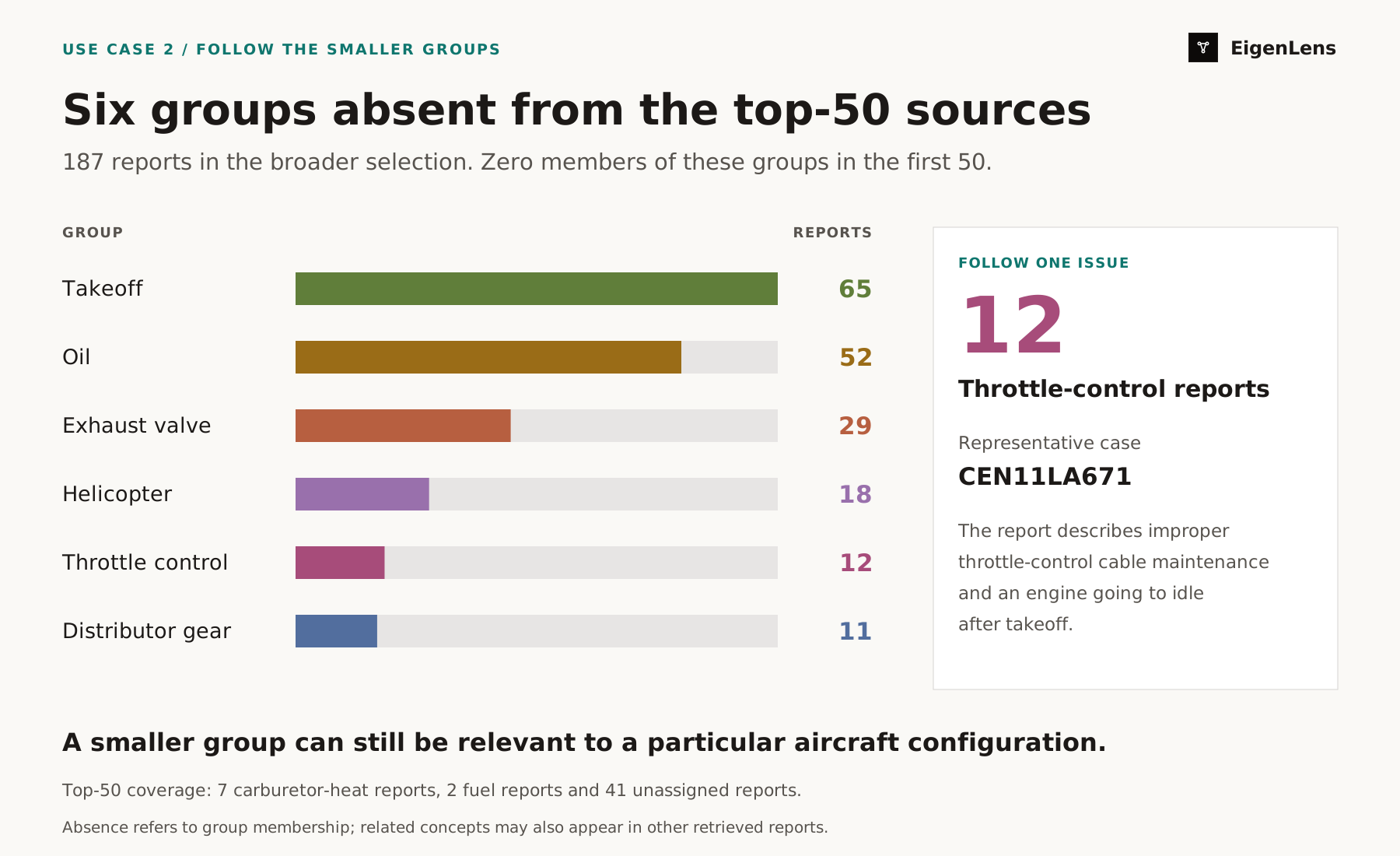
The coverage comparison below concerns the retrieved source records. We have not scored the generated answer’s quality.
See the issues behind the reports
With EigenLens, the same request can trigger an analysis of the complete matching selection:
Show issues in engine power loss during takeoff.
The analysis returned eight clusters containing 1,172 reports, with 2,197 reports unassigned.
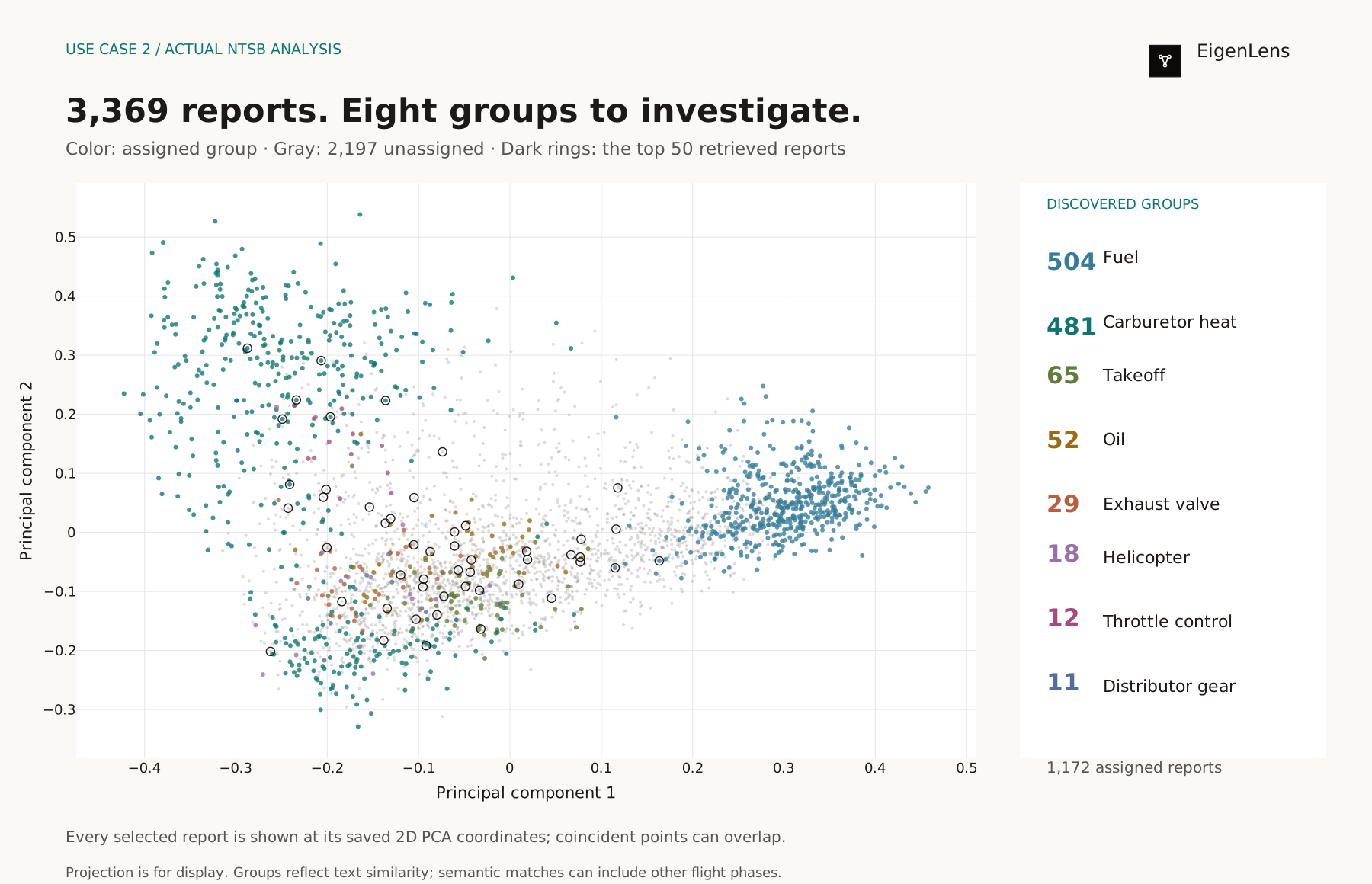
| Issue or context surfaced | Reports |
|---|---|
| Fuel-related issues | 504 |
| Carburetor heat and icing | 481 |
| Takeoff performance and aborted takeoffs | 65 |
| Oil and connecting-rod problems | 52 |
| Exhaust-valve problems | 29 |
| Helicopter operating context | 18 |
| Throttle controls and cables | 12 |
| Distributor gears and ignition | 11 |
The descriptions above summarize issues and context surfaced by the topic phrases and representative reports. The underlying groups reflect similar text and provide investigation starting points; they do not establish eight distinct failure mechanisms.
The smaller groups make the difference concrete:
- Oil: representative case
CEN24FA212describes oil starvation associated with loose turbocharger oil-line fittings. - Exhaust valve: case
WPR22LA334describes a fatigue fracture of an exhaust-valve head. - Throttle control: case
CEN11LA671describes improper throttle-control cable maintenance and an engine going to idle after takeoff.
None of these three groups appeared in the top-50 selection. Their lower volume does not determine their importance to a particular fleet.
How the agent’s evidence changes
| Typical retrieval-only RAG | RAG + EigenLens | |
|---|---|---|
| Evidence examined here | Top 50 matching reports | All 3,369 threshold matches |
| Cluster coverage observed | Two of eight groups represented | Eight groups discovered across the selection |
| Evidence available to the agent | Relevant passages and source IDs | Passages, group sizes, topic phrases, examples and plot coordinates |
| Next question | Retrieve or inspect more cases | Explore a group, its examples and unassigned records |
Retrieval supplies the individual cases. EigenLens adds a way to inspect recurring patterns across the selected evidence.
A clearer review agenda for your aviation company
Engineering can check component-related cases against the fleet’s models and configurations. Training can review fuel-management and carburetor-heat themes in their original context. Reliability teams can keep smaller groups visible alongside the largest themes.
The business value is a more focused review: shared evidence, clearer ownership and fewer blind spots. A twelve-report group may deserve attention if it closely matches your aircraft; a larger group may be less applicable.
These results support review priorities; they do not establish fleet-specific failure rates or measured savings.
Try the workflow
Your existing agent can keep its retrieval tools and connect to EigenLens through MCP. Selected records and stored vectors are copied to a separate analysis worker, which returns structured results and job progress.
Use the agent setup guide to connect your agent to EigenLens. To repeat this example, index the NTSB narratives in a compatible collection using the embedding model below; our local collection is named ntsb_aviation_minilm. Once connected, ask:
Show issues in engine power loss during takeoff.
Then follow the evidence:
Show examples from the largest cluster.
Explain the throttle control topic.
Show the cluster plot in 3D.
Your reliability meeting can begin with source-backed questions your team can investigate, alongside the relevant cases your agent retrieved.
Experiment notes
- Source: NTSB
avall.zip, listed October 1, 2026. Its 31,303 events produced 28,043 prepared records; 3,260 events lacked usable narrative text. Separate pre-2008 archives and later weekly updates were not included. - Preparation: one record per event; unique narrative sections from multiple aircraft were merged. No sampling was used.
- Embeddings: pinned
sentence-transformers/all-MiniLM-L6-v2, 384 dimensions, normalized. Probable cause and final summary precede the factual narrative; the model uses its native 256-token input limit while full prepared text remains stored. - Retrieval: exact cosine search at threshold 0.4, without reranking or diversification. Cluster assignments were checked separately for source coverage and were not supplied to the baseline model.
- RAG-only generation:
nvidia/nemotron-3.5-lightning:free, temperature 0, low reasoning effort, an 8,192-token completion budget, and the same question shown in the story. The model received 50 full narratives and case numbers, used no tools, and returned an answer on the first attempt. Input: 65,562 tokens. The displayed summary was edited for readability and checked against the cited source narratives; the original model response remains saved. Answer quality was not independently scored. - Interpretation: counts describe this selected archive snapshot. Topic labels, reporting templates and semantic matches require source review; unassigned reports remain part of the evidence.
Read the original RAG-only response, retrieval coverage, cluster evidence and dataset provenance.
Explore the patterns in your own vector data.
Get started