Beyond the Stars: What to Fix to Improve Your Amazon Ratings
How product teams can use EigenLens to uncover recurring problems in Amazon reviews and identify improvements worth investigating to improve customer ratings.
Imagine you manage a wireless-headphone brand selling on Amazon. Most customers seem happy, but lower-rated reviews keep arriving. Some describe charging problems. Others complain about calls or say the product did not work as expected.
You want better ratings. Your team needs to know what to change in the customer experience to give future buyers fewer reasons to leave a low rating.
Should you improve reliability, fix a confusing setup step or clarify what the headphones are designed to do? Reading a handful of reviews gives you examples. Choosing a response requires a clearer picture of the recurring experiences.
What is behind the lower ratings—and which problems can your team address?
We explored that question with public headphone reviews and EigenLens. A small group about swimming and water exposure gave us a concrete example of how discovery can guide the next action.
A good rating still leaves unanswered questions
We prepared 30,000 wireless-headphone reviews across 4,654 product IDs from Amazon Reviews 2023, published by McAuley Lab.
The most-reviewed product in our sample averaged 4.09 stars across 1,960 reviews. Yet 492 of those reviews—25.1%—rated it 1–3 stars.
That average tells a product team something about overall reception. It does not explain what those 492 customers experienced, whether their concerns are related, or what a seller should improve for the next buyer.
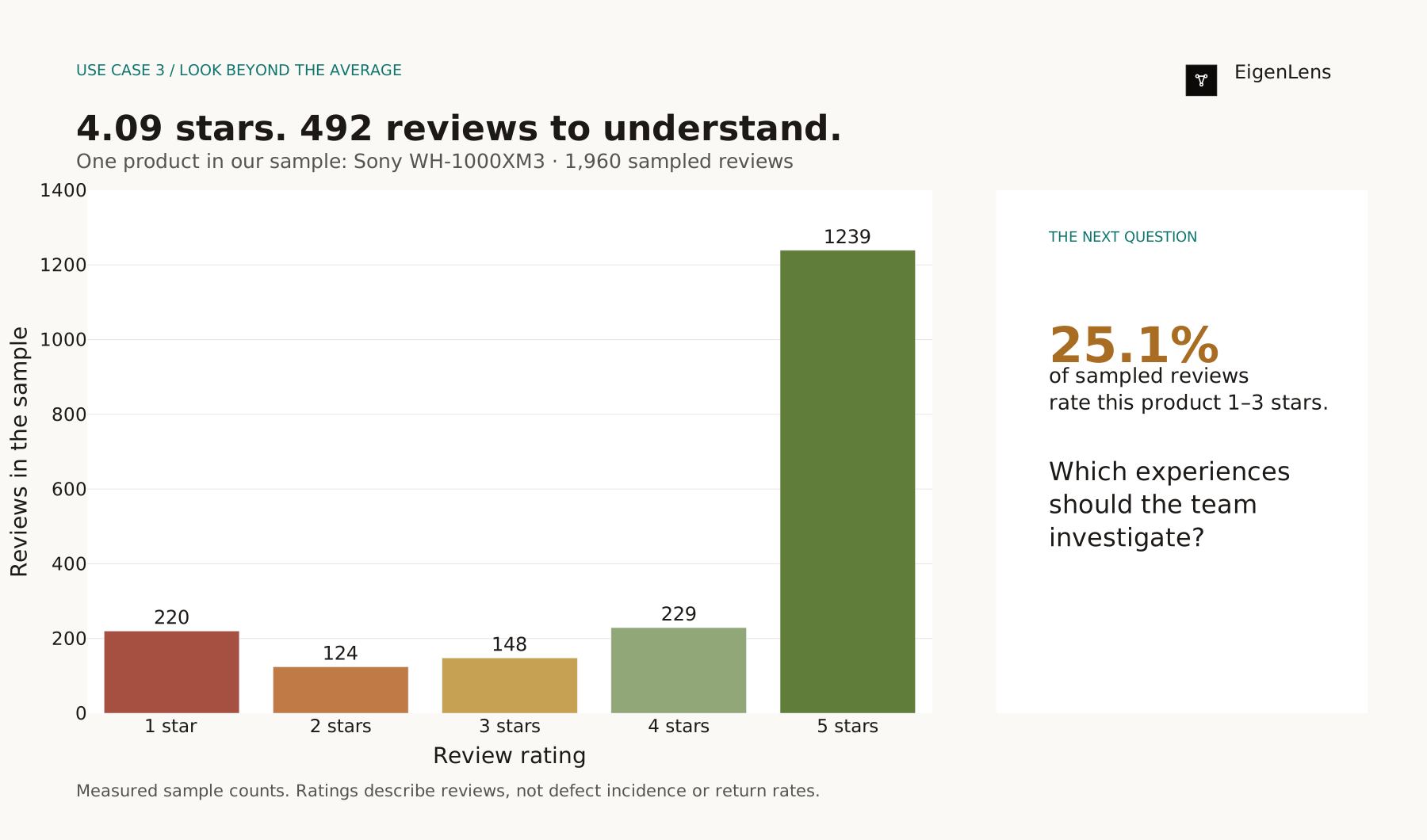
The product is the Sony WH-1000XM3 in this historical dataset. These figures describe our sampled reviews, not all buyers or a current product assessment.
Find recurring experiences behind lower ratings
We indexed the reviews in Qdrant, retaining their ratings, dates and product IDs alongside the customer text.
Then we selected all 8,814 reviews rated 1–3 stars and ran EigenLens over that complete selection. This gives the team a focused starting point for mixed and negative experiences, with links back to the original evidence.
The full analysis produced five groups, with 4,547 reviews unassigned. The output needed interpretation: the largest group was generic, and another largely reflected language. Five groups did not mean five distinct product defects.
But one smaller group was specific enough to follow.
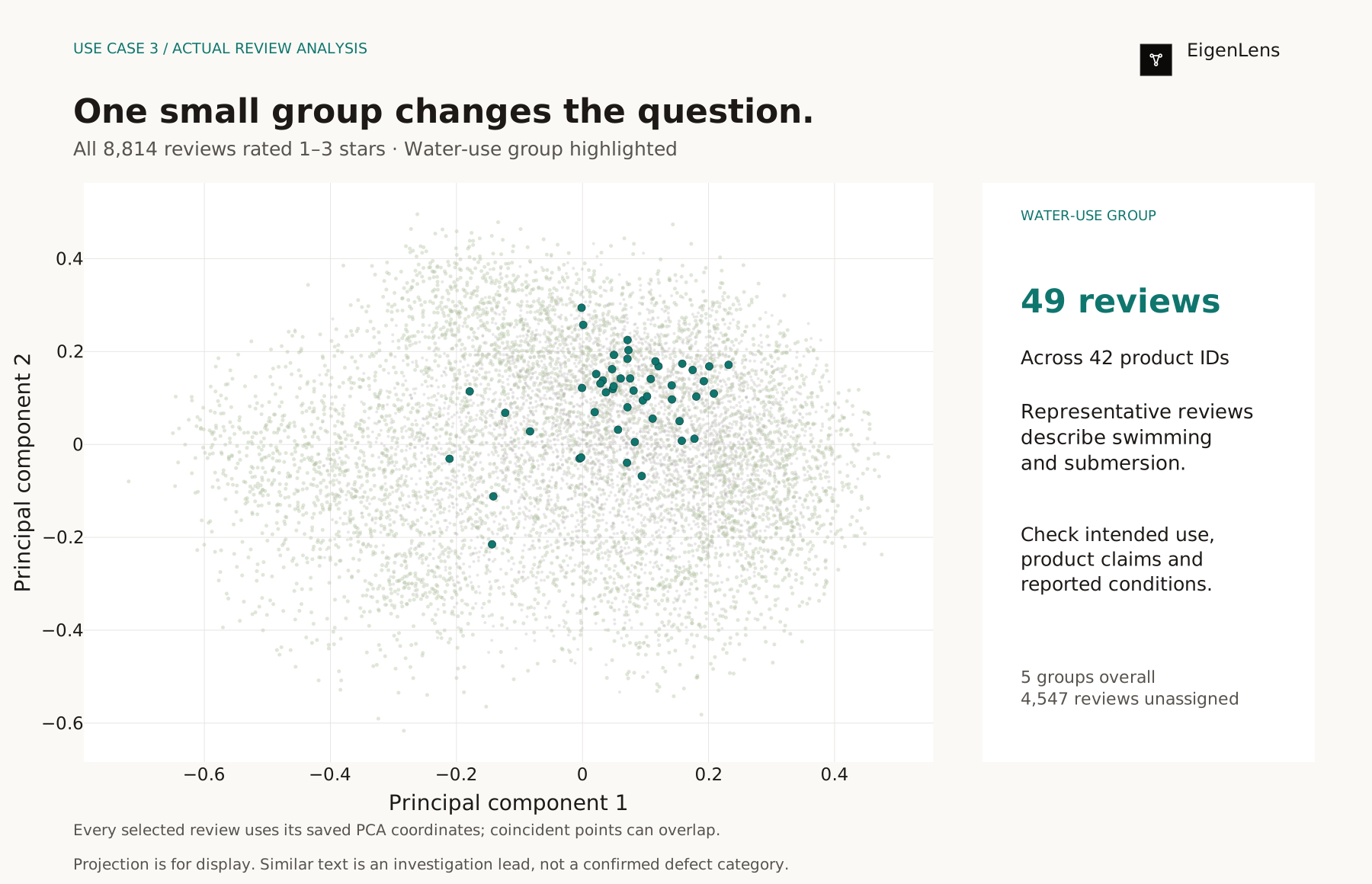
This is a projection for display. The groups come from similarity analysis of the stored review vectors.
The smaller group that changed the question
A group of 49 reviews across 42 product IDs centered on water use, swimming and related experiences.
Opening representative reviews made the context clearer:
- One reviewer described earbuds cutting out when turning their head during swimming, while working better outside the water.
- Another described interruptions when swimming laps or submerging the earbuds, despite finding them usable in ordinary conditions.
These are customer accounts, not reproduced test results. But together they give the product team a more specific question:
Are customers expecting a water-use experience the product is intended and able to provide?
A low rating about water use might call for a product investigation, clearer expectations or both. The rating alone cannot tell the seller which response is appropriate.
The team can check the affected product IDs, read their stated capabilities, inspect how the products are presented and reproduce the reported conditions where appropriate. It can then decide whether the evidence points toward a technical issue, unclear expectations, or both.
Turn a review pattern into a specific improvement
Start by checking whether the finding applies to your own products. This sample spans many brands and product IDs; its counts are discovery leads, not a ranking of problems for any one seller.
| What the team validates | Work it could justify |
|---|---|
| Behavior falls short of stated specifications | An engineering investigation into reliability, materials or design. |
| Buyers misunderstand intended use | Clearer product listings, packaging, onboarding and support guidance. |
| The available accounts are inconclusive | More source review and targeted testing before committing to a change. |
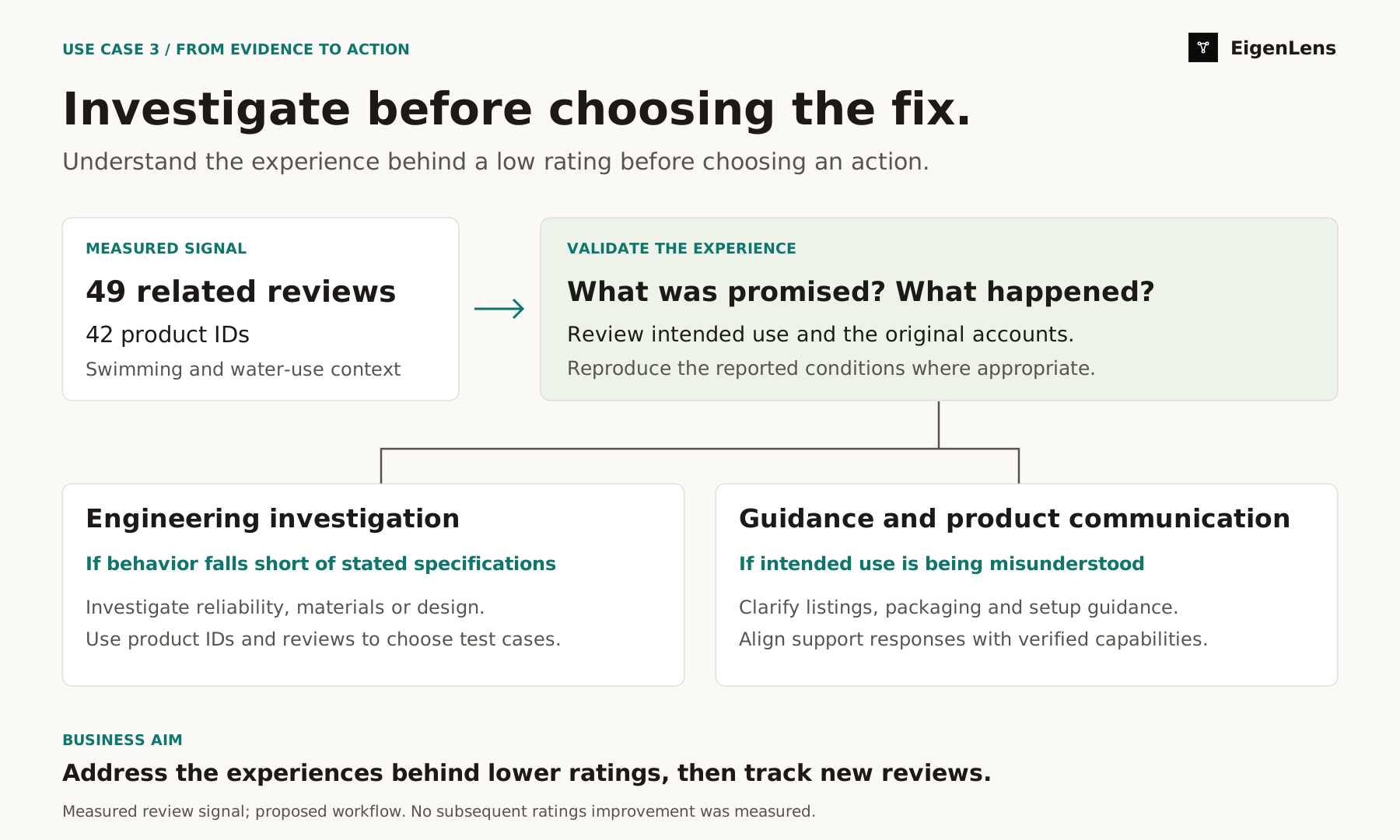
The practical aim is to address the experience behind the low rating. If a verified reliability problem is responsible, the team can investigate the product. If buyers misunderstand a capability, the team can make that capability clearer before purchase and during setup.
EigenLens supplies a recurring pattern and supporting reviews. Product knowledge and validation determine the action.
Explore the other reasons buyers are disappointed
The seller can also explore other potential sources of dissatisfaction. We tested these searches against the lower-rated collection at a similarity threshold of 0.40:
| Search | Matching reviews |
|---|---|
| Headphones charging case problems | 1,299 |
| Bluetooth headphones keep disconnecting | 1,894 |
| Headphones microphone poor call quality | 1,915 |
| Headphones stopped working after a few weeks | 2,470 |
These selections overlap and include semantically related accounts; they are not four independently verified defect categories. Scoped clustering of charging cases, call quality and early failures also remained broad under the current settings. The next step is to inspect examples and product context, not automatically rank these counts as business impact.
Why use EigenLens here?
A ratings dashboard shows how reviews are scored. A search retrieves evidence for a question the team already knows to ask.
EigenLens adds a way to explore how experiences group together across a larger selection, inspect smaller patterns and follow them back to source reviews. In this example, the water-use group gave the team a concrete customer context to investigate beyond its initial charging and call-quality questions.
The useful progression is reviews → recurring experiences → validated problem → targeted change. That connects feedback analysis to the work that could improve customer satisfaction and future ratings.
Check whether newer reviews improve
After a change, return to the reviews for the affected product IDs. Look at:
- The share of new reviews rated 1–3 stars. Has the distribution changed?
- The share describing the validated problem. Does the same frustration keep appearing?
- The remaining examples. Do they suggest the change helped, missed the issue or introduced a new one?
Use consistent product scope and comparable time windows. A before-and-after comparison helps monitor progress; it does not by itself establish what caused a change in ratings.
This is the proposed next step, not a result of our experiment: we have not deployed a product change or measured a subsequent ratings lift.
Try the example
The collection names below refer to our prepared local demo. To reproduce the workflow, prepare a comparable review selection and connect your agent using the EigenLens setup guide.
In that demo, select headphone_reviews_critical_minilm in EigenLens Chat and ask:
Show clusters.
In the measured full-selection result, the water-use group is topic 2:
Show examples from topic 2.
For a fresh scoped analysis, start a new chat on the same collection and ask:
Show clusters for headphones charging case problems.
Topic IDs can change when the selection or analysis changes. The collection headphone_reviews_30k_minilm contains the full sample across all ratings.
Improving ratings starts with understanding the experiences that produce them. The seller now has a specific customer context to examine, evidence to validate and a way to revisit feedback after taking action.
About the example: The opening product-team scenario illustrates a decision workflow; the review counts and analysis results are measured. This is a reproducible convenience sample from a historical dataset ending in 2023, not a representative customer survey. Identical review text was removed, product filtering is heuristic, and some reviews are in languages other than English. Review frequency does not establish defect incidence, confirmed returns, churn or financial loss. The manifest and saved results document the scope.
Explore the patterns in your own vector data.
Get started